Silicon in Climate-Smart Agriculture: Beyond Plant Nutrition
Climate change is no longer a distant projection—it is a present and accelerating reality reshaping global agriculture. Increasing temperatures, erratic rainfall patterns, prolonged droughts, soil salinization, and extreme weather events are placing unprecedented pressure on agricultural systems. At the same time, agriculture itself contributes significantly to greenhouse gas (GHG) emissions, soil degradation, and nutrient losses. This dual challenge—ensuring food security while mitigating environmental impacts—lies at the heart of climate-smart agriculture.
Climate change is no longer a distant projection—it is a present and accelerating reality reshaping global agriculture. Increasing temperatures, erratic rainfall patterns, prolonged droughts, soil salinization, and extreme weather events are placing unprecedented pressure on agricultural systems. At the same time, agriculture itself contributes significantly to greenhouse gas (GHG) emissions, soil degradation, and nutrient losses. This dual challenge—ensuring food security while mitigating environmental impacts—lies at the heart of climate-smart agriculture.
Within this context, silicon (Si) is emerging as a remarkably underappreciated element. Traditionally regarded as a “beneficial” but non-essential nutrient, silicon has often been discussed primarily in relation to plant structural support and stress tolerance. However, recent research suggests that silicon’s role extends far beyond plant nutrition. It may function as a biogeochemical regulator with implications for carbon sequestration, greenhouse gas mitigation, nutrient cycling, and long-term soil resilience.
It is time to reconsider silicon—not merely as a supplementary amendment—but as a strategic component of climate-smart soil systems.
Silicon: More Than a Beneficial Element
Silicon is the second most abundant element in the Earth’s crust, yet its agronomic role has historically been underestimated. While not classified as essential for all plant species, silicon has consistently demonstrated significant benefits across a wide range of crops, particularly under stress conditions.
Silicon enhances plant tolerance to:
-
Drought stress
-
Salinity stress
-
Heavy metal toxicity
-
Pathogen and pest pressure
-
Lodging in cereals
Mechanistically, silicon is deposited in plant tissues as amorphous silica (SiO₂·nH₂O), forming physical barriers that strengthen cell walls and reduce transpirational water loss. Beyond structural reinforcement, silicon also modulates physiological and biochemical processes, including antioxidant activity, osmotic regulation, and stress signaling pathways.
Under drought conditions, silicon improves water-use efficiency and maintains photosynthetic performance. In saline environments, it reduces sodium uptake and mitigates ionic imbalance. Under heavy metal stress, silicon can immobilize toxic elements in soil or reduce their translocation within plant tissues.
These functions alone justify silicon’s inclusion in stress-resilient agriculture. However, its broader environmental implications are even more compelling.
Silicon and Carbon Sequestration: The Phytolith Pathway
One of the most intriguing aspects of silicon in agriculture relates to its role in carbon sequestration through phytolith formation.
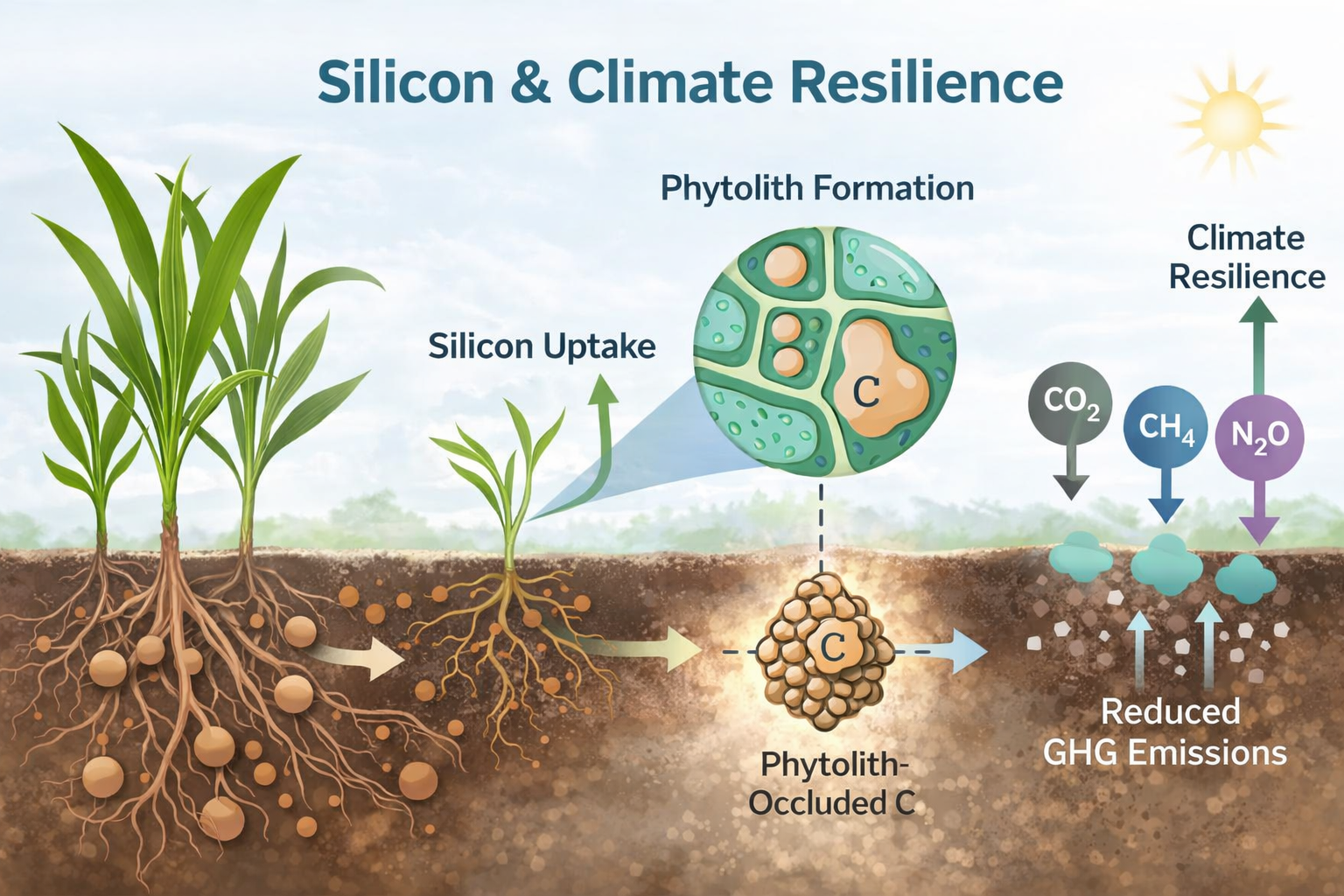
Many plants—particularly grasses and cereals—accumulate silicon in the form of phytoliths, microscopic silica bodies deposited within plant tissues. During phytolith formation, a fraction of organic carbon becomes occluded within these silica structures. This carbon, referred to as phytolith-occluded carbon (PhytOC), can remain stabilized in soils for extended periods, potentially ranging from decades to millennia.
Unlike conventional soil organic carbon, which is susceptible to rapid microbial decomposition, PhytOC is physically protected within silica matrices. This enhances its resistance to mineralization and contributes to long-term carbon storage.
In climate-smart agriculture, increasing attention is being directed toward strategies that enhance stable carbon pools. Silicon-mediated phytolith formation offers a biologically integrated pathway for carbon sequestration that operates within normal plant growth processes.
If managed strategically—particularly in silicon-accumulating crops such as rice, wheat, and sugarcane—this pathway may contribute meaningfully to soil carbon stabilization. Although further field-scale quantification is required, the phytolith mechanism represents an underexplored opportunity in climate mitigation research.
Silicon and Greenhouse Gas Mitigation
Agricultural soils are significant sources of nitrous oxide (N₂O), a greenhouse gas with a global warming potential approximately 298 times greater than carbon dioxide over a 100-year period. N₂O emissions are closely linked to nitrogen fertilization practices, soil microbial activity, and nutrient inefficiencies.
Silicon may influence greenhouse gas dynamics indirectly through its interactions with nitrogen cycling and plant physiology.
Several potential mechanisms include:
-
Improved Nitrogen Use Efficiency (NUE)
Silicon-enhanced root systems and stress tolerance may increase nitrogen uptake efficiency, reducing surplus nitrogen in soils and consequently lowering N₂O emissions. -
Modulation of Soil Microbial Communities
Silicon amendments may alter rhizosphere conditions, influencing microbial processes such as nitrification and denitrification. -
Reduced Plant Stress
Healthier, stress-resilient plants are less likely to contribute to inefficient nutrient turnover and soil carbon losses.
Although empirical data remain limited and sometimes inconsistent, emerging evidence suggests that silicon could play a supportive role in reducing nitrogen losses and associated greenhouse gas emissions.
Within integrated nutrient management systems, silicon deserves consideration as a complementary tool for improving nutrient efficiency and environmental performance.
Silicon in Degraded and Stressed Soils
Soil degradation—characterized by declining organic matter, compaction, erosion, salinity, and contamination—is a global concern. In many regions, especially in developing countries, degraded soils are a major constraint to sustainable food production.
Silicon has demonstrated potential in ameliorating several degradation-related challenges:
-
Enhancing soil aggregation through plant-mediated processes
-
Reducing heavy metal bioavailability
-
Improving crop performance under salinity
-
Supporting resilience in low-fertility soils
In highly weathered tropical soils, where plant-available silicon may be limited due to leaching, targeted silicon management could restore functional balance within soil–plant systems.
Importantly, silicon’s effects are often more pronounced under stress conditions. This aligns directly with the goals of climate-smart agriculture, which prioritizes resilience under adverse environmental scenarios.
Why Is Silicon Still Underutilized?
Despite its promising roles, silicon remains underrepresented in agricultural policy and management frameworks.
Several factors contribute to this gap:
-
Classification Limitations
Silicon is not universally recognized as an essential nutrient, limiting its inclusion in fertilizer recommendations. -
Regional Variability
Silicon availability varies widely depending on soil type, mineralogy, and climate, complicating universal guidelines. -
Limited Long-Term Field Trials
While controlled experiments demonstrate benefits, large-scale, multi-season field studies are still relatively scarce. -
Incomplete Mechanistic Understanding
The interactions between silicon, soil microbiomes, and biogeochemical cycles remain insufficiently understood. -
Policy Inertia
Climate-smart agriculture frameworks often focus heavily on carbon and nitrogen management, with limited integration of silicon dynamics.
Addressing these limitations requires coordinated research efforts and interdisciplinary collaboration.
Future Research Directions
To fully integrate silicon into climate-smart agriculture, several research priorities deserve attention:
-
Silicon–Microbiome Interactions
How does silicon influence rhizosphere microbial communities and nutrient transformations? -
Silicon and Nitrogen Coupling
Can silicon amendments consistently reduce N₂O emissions under field conditions? -
Silicon in Degraded Tropical Soils
What are the long-term effects of silicon supplementation in highly weathered soils? -
Silicon and Emerging Stressors
Could silicon mitigate combined stresses such as microplastic contamination and heavy metal toxicity? -
Phytolith Carbon Quantification
How significant is phytolith-occluded carbon at ecosystem and regional scales? -
Integration into Regenerative Agriculture
Can silicon management be aligned with conservation tillage, cover cropping, and organic amendments?
These questions highlight that silicon research is not merely agronomic—it intersects with soil ecology, climate science, environmental chemistry, and sustainability studies.
For researchers and graduate students, this represents a fertile and interdisciplinary field of investigation.
Reframing Silicon in Climate-Smart Agriculture
Silicon should no longer be viewed solely as a structural enhancer or stress-mitigating amendment. Its broader implications for carbon stabilization, greenhouse gas mitigation, nutrient efficiency, and soil resilience suggest a more systemic role.
In climate-smart agriculture, the goal is not only to increase productivity but to optimize ecological function. Silicon appears to operate at the intersection of plant physiology and soil biogeochemistry, making it uniquely positioned to contribute to resilient agroecosystems.
While substantial knowledge gaps remain, the conceptual shift is clear: silicon is not just a beneficial element—it is a strategic component of sustainable soil systems.
As climate pressures intensify and the need for environmentally responsible agriculture becomes more urgent, revisiting overlooked elements like silicon may provide innovative pathways toward resilient and regenerative food systems.